

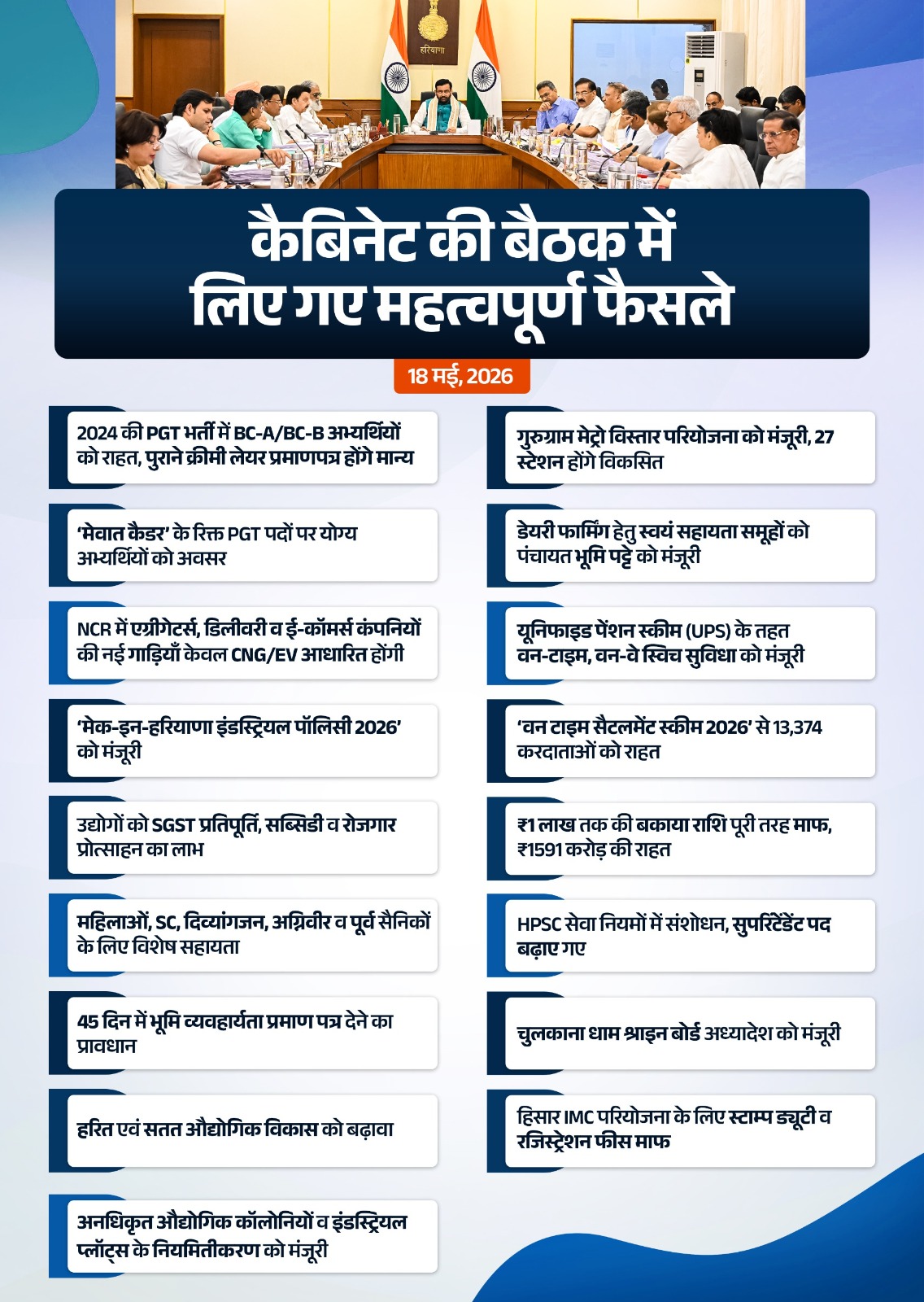
Policies to drive Rs. 5 lakh crore investment, 10 lakh jobs and a future-ready Haryana
Massive push for investment, jobs, AI, electronics, exports and agro-industry marks a new growth pivot for Haryana
Chandigarh, May 18
Signalling a decisive shift from intent to execution, the Haryana Cabinet, which met under the chairmanship of Chief Minister Nayab Singh Saini, here today approved 10 major industrial policies that seek to operationalise key Sankalp Patra commitments and budget announcements through an expansive push in manufacturing, digital infrastructure, emerging technologies, green industry and agro-based economic growth.
Notably, before finalising these policies, Chief Minister Nayab Singh Saini personally held detailed consultations with industrialists and industry associations over two days. Furthermore, the said policies have been prepared in line with Prime Minister Sh. Narendra Modi’s vision of Viksit Bharat and Make in India.
Make in Haryana Industrial Policy 2026
The Cabinet approved the Draft Make in Haryana Industrial Policy 2026. This policy will replace HEEP 2020 and will serve as the State’s main industrial policy. It aims to attract Rs. 5 lakh crore of new investment, generate 10 lakh new jobs and increase the State’s exports over the next five years.
The new policy replaces the earlier A, B, C and D block-based area classification system with a new framework based on Core, Intermediate, Sub-Prime and Prime/Focus Areas. In the Budget for FY 2026-27, it was announced that financial incentives would be made available for industrial investment across all blocks. Through this policy, incentives will now reach every block of the State.
The policy provides for capital subsidy for new industrial investment, recruitment of youth registered on the Haryana Kaushal Rozgar Nigam portal, and incentives for research and development. Net SGST reimbursement will range from 30 percent to 70 percent. Large units will get this benefit for 7 years, mega units for 10 years and Ultra Mega projects for up to 12 years under special packages. Large units will be eligible for capital subsidy of 5 percent to 20 percent, while Mega and Ultra Mega units in Prime/Focus Areas will be eligible for capital subsidy of up to 30 percent.
To promote local employment, the employment generation subsidy has been increased from Rs. 48,000 to up to Rs. 1 lakh per employee per year for 10 years. For women, Scheduled Castes, Divyangs, Agniveers and ex-servicemen, this assistance will be up to Rs. 1.20 lakh. In line with the Sankalp Patra commitment, units hiring through the Haryana Kaushal Rozgar Nigam portal will get reimbursement of both employer and employee EPF contributions.
To ensure timely payments to investors, a provision has been made to pay interest at 8 percent per annum in case of delay after April 1, 2026. Fifty percent of the eligible incentive will be released within 7 working days and the remaining amount within 45 days. Through the Land Feasibility Certificate, clarity on land ownership, land use and status of related approvals will be provided within 45 working days. Provisions have also been made for export promotion and green industries, including carbon credits, renewable energy, green buildings and zero liquid discharge systems.
Haryana Electronics System Design and Manufacturing Policy 2026
The Cabinet approved the Draft Haryana Electronics System Design and Manufacturing Policy 2026. In the Budget for FY 2026-27, it was announced that a policy for this sector would be prepared and implemented during the current year. This policy will promote investment in electronics manufacturing, electronic components and semiconductors in the State.
An electronics manufacturing cluster is being developed over 500 acres at IMT Sohna. Under the policy, capital assistance of 20 percent to 30 percent will be provided, subject to a maximum of Rs. 200 crore per unit. Operational assistance of 50 percent to 80 percent will also be provided, subject to a maximum of Rs. 20 crore per year. Electronics products made in Haryana will be given preference in government procurement. A separate policy for the semiconductor sector is also being prepared.
Haryana Pharmaceutical and Medical Devices Manufacturing Policy 2026
The Cabinet approved the Draft Haryana Pharmaceutical and Medical Devices Manufacturing Policy 2026. In the Budget for FY 2026-27, it was announced that a policy for this sector would be prepared and implemented during the current year. This policy will promote investment in medicines, medical devices, clinical trials, bioequivalence studies and healthcare manufacturing.
The policy aims to attract Rs. 10,000 crore of investment and generate 20,000 jobs. Eligible units will receive capital assistance of 20 percent to 30 percent, subject to a maximum of Rs. 200 crore per unit, and operational assistance of 50 percent to 80 percent, subject to a maximum of Rs. 20 crore per year. Provisions have also been made to allow women to work in night shifts, declare eligible units as essential services, and provide fast-track approval for already approved drug formulations.
Haryana Toys and Sports Equipment Manufacturing Policy 2026
The Cabinet approved the Draft Haryana Toys and Sports Equipment Manufacturing Policy 2026. In the Budget for FY 2026-27, it was announced that this policy would be implemented during the current year. It will promote manufacturing, exports, design, innovation and MSME participation in the toys and sports equipment sector.
India has reduced import dependence and increased exports in the toys sector. Haryana will promote the manufacturing of science, technology, engineering and mathematics-based toys, smart toys, eco-friendly toys and high-value sports equipment. Under the policy, capital assistance of 30 percent will be provided, subject to a maximum of Rs. 50 crore per unit. Operational assistance of 70 percent will be provided for five years, subject to a maximum of Rs. 3 crore per year. The policy targets Rs. 5,000 crore of investment and 25,000 jobs.
Haryana Electronics Waste Recycling Policy 2026
Cabinet approved the Draft Haryana Electronics Waste Recycling Policy 2026. In the Budget for FY 2023-24, it was announced that a recycling facility incentive policy would be prepared. This policy will promote e-waste collection, segregation, recycling, certification and formal recycling systems.
With the expansion of the digital economy, e-waste is increasing rapidly. Haryana will turn this challenge into an opportunity by creating green jobs and converting old electronic devices into raw material for next-generation devices. Under the policy, capital assistance of 30 percent will be provided, subject to a maximum of Rs. 25 crore per unit. Operational assistance of 70 percent will be provided for five years, subject to a maximum of Rs. 2 crore per year. Haryana-registered recycling units will be given preference in government procurement.
Haryana Global Capability Centres Policy 2026
The Cabinet approved the Draft Haryana Global Capability Centres Policy 2026. This policy is in line with the announcement made by Chief Minister Nayab Singh Saini in September 2025 to bring a dedicated policy for making Gurugram and Haryana the global capital of Global Capability Centres.
India has nearly 1,700 Global Capability Centres and Haryana already has more than 270 such centres. Through this policy, the State aims to attract more than 100 new Global Capability Centres to Haryana. A dedicated mission, single-window desk in Gurugram, investor matchmaking platform and advisory council will be established. Operational assistance will be provided for 5 to 9 years, subject to a maximum of Rs. 15 crore per year.
Haryana IT/ITeS, AI and Emerging Technologies Policy 2026
The Cabinet approved the Draft Haryana IT/ITeS, AI and Emerging Technologies Policy 2026. This policy is aligned with Digital India, the National AI Mission and the Government’s priorities to promote emerging technologies in the State. It will encourage investment and employment in information technology, IT-enabled services, artificial intelligence, blockchain, cyber security, Internet of Things and cloud-based services.
Haryana already has an information technology and IT-enabled services sector of more than Rs. 1.55 lakh crore. A Global Artificial Intelligence Centre will be set up in Gurugram and the Haryana Advanced Computing Facility will be established in Panchkula. More than 50,000 professionals will be trained. Three Centres of Excellence will be established, with each centre eligible for capital assistance of up to Rs. 10 crore and operational assistance of up to Rs. 2 crore per year.
Haryana AVGC-XR Policy 2026
The Cabinet approved the Draft Haryana AVGC-XR Policy 2026. In the Budget for FY 2026-27, it was announced that this policy would be implemented during the current year. It will promote studios, content creation, intellectual property and skill development in areas such as animation, visual effects, gaming, comics and extended reality.
The Union Budget has recognised the creative economy as the Orange Economy. This sector has the potential to generate 20 lakh jobs in India by 2030. Under the policy, capital assistance of 20 percent to 30 percent will be provided, subject to a maximum of Rs. 50 crore per unit. Three Centres of Excellence will be established in collaboration with institutions of national importance.
New Haryana Data Centre Policy 2026
The Cabinet approved the Draft New Haryana Data Centre Policy 2026. In the Budget for FY 2026-27, it was announced that a data centre policy would be prepared and implemented during the current year. This policy will strengthen the data infrastructure required for artificial intelligence, cloud computing, 5G services and digital governance.
Haryana will attract data centre investors through its proximity to the National Capital, reliable power supply, relaxation of floor area ratio up to 500 percent, dual grid supply and essential service status. Hyper Data Centres above 10 MW will receive capital assistance of 20 percent, subject to a maximum of Rs. 25 crore, and operational assistance of 50 percent, subject to a maximum of Rs. 8 crore per year. Data Centre Parks will receive additional assistance and 5 percent interest subsidy on loans.
Haryana Agri Business and Agro Processing Policy 2026
The Cabinet also approved the Haryana Agri Business and Agro Processing Policy 2026. This policy is a major step towards increasing farmers’ income, promoting value addition in agricultural produce and strengthening the rural economy. Haryana’s farmers have played an important role in the country’s food security, and the Government now aims to ensure better prices for their produce.
Under the policy, food processing units, cold chain infrastructure, food parks, packaging units, food testing laboratories and incubation centres will be promoted. This will strengthen linkages between farmers, FPOs, processing units and markets, and reduce post-harvest losses.
The policy aims to attract investment of more than Rs. 5,000 crore and generate nearly 30,000 jobs. Special incentives have been provided for women entrepreneurs, Scheduled Caste category, Divyangjan, ex-servicemen, export-oriented units and joint ventures with foreign investors. A Centre of Excellence will be established for innovation, technology and skill development in the food processing and packaging sector.
Common incentive framework for the first 9 policies
Except for the Agri Business and Agro Processing Policy, the other 9 policies follow a common incentive framework. Under this, units promoting local employment will receive employment generation subsidy of up to Rs. 1 lakh per employee per year for 10 years. For women, Scheduled Castes, Divyangs, Agniveers and Ex-servicemen, this assistance will be up to Rs. 1.20 lakh.
Units hiring through the Haryana Kaushal Rozgar Nigam portal will receive 100 percent reimbursement of both employer and employee EPF contributions for five years. Assistance of up to Rs. 5 crore will be provided for relocation of domestic units and up to Rs. 10 crore for relocation of international units.
Exports, green energy, zero liquid discharge systems and patent commercialization will also be promoted. Assistance of up to Rs. 50 lakh will be provided for commercialisation of domestic patents and up to Rs. 1 crore for international patents. Units availing benefits under the Government of India’s Production Linked Incentive Scheme or other major schemes may choose a 50 percent state top-up on the amount received from the Government of India instead of the standard State incentive package.
Private industrial park developers will have the option to choose between capital subsidy and net SGST reimbursement. Such parks will also receive 100 percent stamp duty reimbursement, subject to a maximum of Rs. 45 crore per park. The eligibility threshold for expansion projects has been simplified to 25 percent of existing fixed capital investment, and the Job Readiness Programme has been extended to six months.
The significance of these policies lies not only in the incentives, but in the broader vision behind them. From semiconductors to creative industries, from life-saving medicines to green recycling, and from digital infrastructure to agriculture-based industries, these policies will define the new industrial direction of modern Haryana. The Government’s aim is to make Haryana a leading State in the next phase of investment, employment, exports, innovation and rural prosperity.



Leave feedback about this