

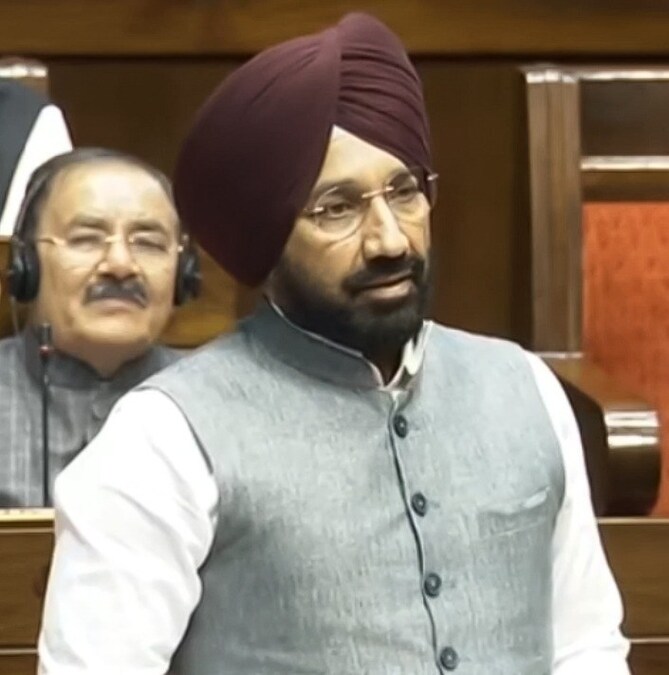
Rising level of toxic elements in Punjab’s groundwater poses a serious threat to the lives of residents: MP Satnam Singh Sandhu
New Delhi, Dec 12
Rajya Sabha Member of Parliament Satnam Singh Sandhu raised the issue of increasing levels of uranium, nitrate and other harmful elements in the groundwater of Punjab during the Winter Session of Parliament through a Special Mention in the Rajya Sabha.
Sandhu said that according to the latest Annual Groundwater Report 2025 released by the Central Ground Water Board (CGWB), alarming data has come to light. “As per the report, 62.5 percent of the groundwater samples from Punjab contain uranium levels beyond the permissible limit — the highest among all 28 states of India. This is not merely an environmental crisis but a public health emergency for the people of Punjab. More than half the samples show uranium concentration above 30 parts per billion (ppb), which is causing cancer and kidney-related diseases among future generations,” he said.
He added that 14.6 percent of the samples contain excessive nitrate levels, and 11 percent show high fluoride content, exposing children to life-threatening diseases like Blue Baby Syndrome and deformities related to bone health.
The MP further stated, “Toxic groundwater has also become a threat to agriculture in Punjab, as 25 percent of the samples contain residual sodium carbonate. Rising water salinity is turning our fertile lands barren. I strongly urge the Central Government to launch an emergency Special Groundwater Mitigation Mission to save Punjab from this crisis.”
Sandhu also demanded that community-based RO water purification systems be installed on a war footing in affected villages and health screening camps be organized in the impacted areas. He suggested that deep aquifer mapping be carried out to identify safe sources of drinking water.
“Water is a national asset, and urgent action is required to protect it. Punjab, which feeds the entire nation, now has its people forced to drink toxic water. Farmers, our Annadatas (providers of food), deserve protection of their health — immediate steps must be taken in this direction,” he said.
According to the recent CGWB report, Punjab is the most affected state, with uranium levels exceeding the safe limit of 30 ppb in 53.04 percent of pre-monsoon samples and 62.5 percent of post-monsoon samples. Compared to 2024, when 32.6 percent of the samples were found contaminated, this year’s share of samples crossing the safety threshold has risen to 62.5 percent — a worrying increase of 91.7 percent.
The report further classified 16 out of Punjab’s 23 districts as “contaminated,” including Tarn Taran, Patiala, Sangrur, Moga, Mansa, Barnala, Ludhiana, Jalandhar, Kapurthala, Firozpur, Fazilka, Fatehgarh Sahib, Faridkot, Amritsar, Muktsar, and Bathinda.




Leave feedback about this